Silver has achieved a historic milestone, surging past the $75 per ounce mark to set a verified all-time high of $75.27/oz (as of December 29, 2025, 01:50 AM EST). This monumental rally caps its best month and year since 1979, driven by a confluence of powerful factors: impending supply shocks from China, relentless industrial demand, and a notably dovish Federal Reserve. While volatility remains extreme and market positioning appears crowded, the trajectory of this precious metal’s next significant move will largely hinge on evolving supply dynamics and broader macroeconomic risks.
Current Market Dynamics: A Parabolic Ascent
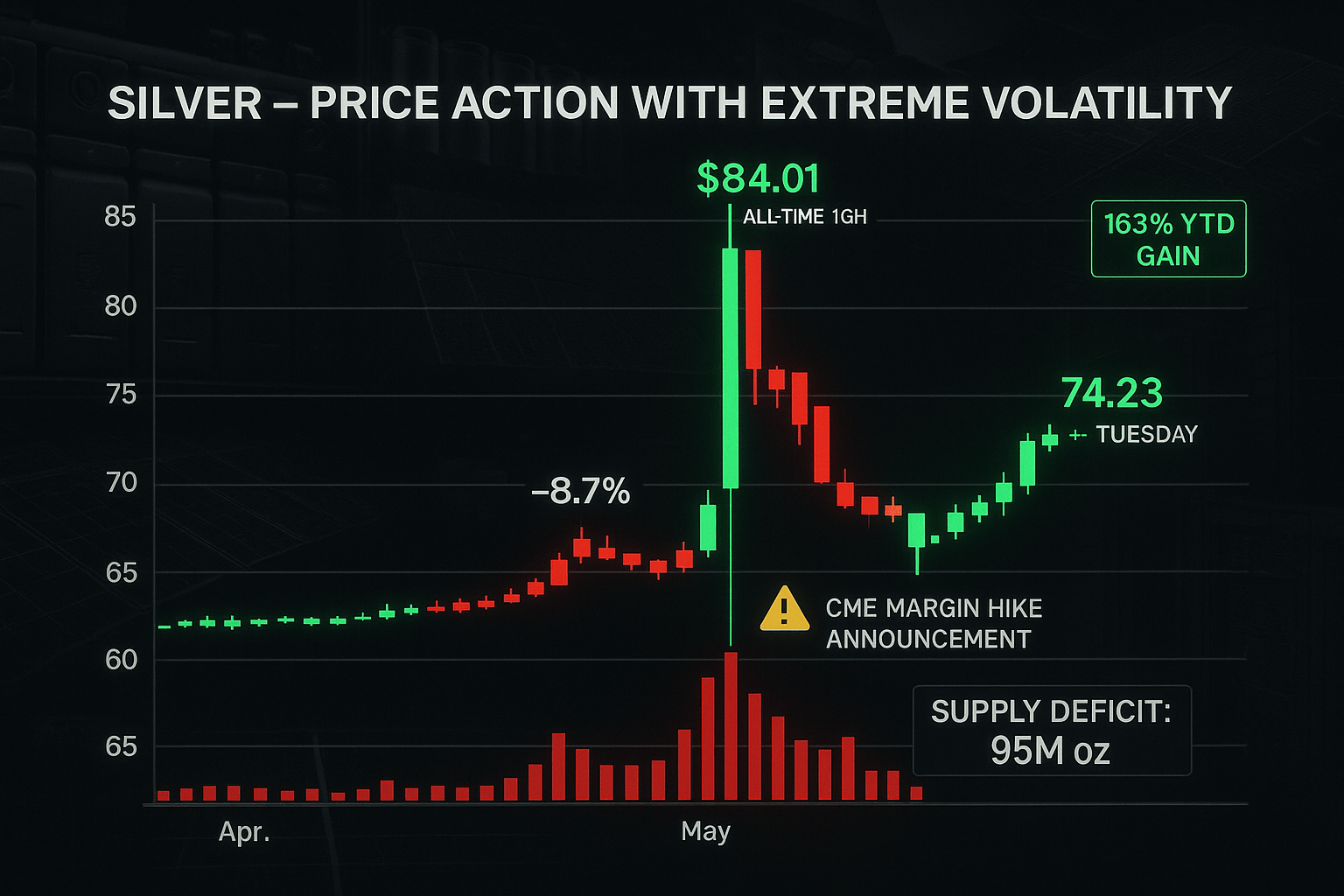
The silver market is currently in a phase of consolidation just above the $75 threshold, following a parabolic surge that saw intraday highs flirt with $75.68 and a brief, albeit sharp, spike above $80 in thin year-end trading. Trading volumes on COMEX and within Exchange Traded Funds (ETFs) have reached multi-year peaks, signaling robust market activity. A critical indicator of acute physical tightness is the record $8–10 premium for Shanghai spot silver, highlighting a significant disparity between paper and physical markets. This period of extraordinary outperformance by silver is further underscored by the collapse of the gold/silver ratio to 60, a level not seen in years.
Key Drivers Propelling Silver's Historic Rally
China's Looming Export Curbs
A primary catalyst for silver’s dramatic ascent is the impending restriction on exports from China, as reported by Reuters. Effective January 1, 2026, China, which accounts for an estimated 60–70% of global silver refining, will limit exports to only state-approved firms. This pivotal policy shift has ignited a global scramble for physical metal, embedding a significant “war premium” into prices. Industry leaders, including Tesla’s Elon Musk, have voiced concerns over potential supply risks for critical sectors like electric vehicles (EVs) and solar energy, both heavily reliant on silver.
Persistent Supply Deficit
The structural imbalance in the silver market continues to intensify. Reports from the Silver Institute and Bloomberg confirm a fifth consecutive annual supply deficit, with the shortfall for 2025 projected to be between 95 and 120 million ounces. This persistent deficit has severely depleted inventories on major exchanges like COMEX and LBMA, pushing them to multi-year lows. Concurrently, the paper-to-physical ratio has ballooned to an unprecedented 356:1, further accentuating the scarcity of physical silver.
Dovish Federal Reserve Policy
The Federal Reserve's monetary policy in 2025 has played a crucial role in bolstering precious metals. Three rate cuts by the Fed, coupled with dovish forward guidance, have suppressed real yields and weakened the U.S. dollar. This environment typically funnels investment capital into hard assets like silver and gold, offering a hedge against inflation and currency devaluation.
Surging Industrial Demand
Beyond its role as a monetary metal, silver is an indispensable industrial commodity. Demand from rapidly expanding sectors such as solar energy, electric vehicles, and advanced AI hardware remains robust and largely price-inelastic. The International Energy Agency (IEA) projects that by 2030, solar and EV manufacturing alone could consume half of the global silver output, highlighting the immense and growing industrial appetite for the metal.
Technical Structure: Anatomy of a Breakout
Trend Analysis
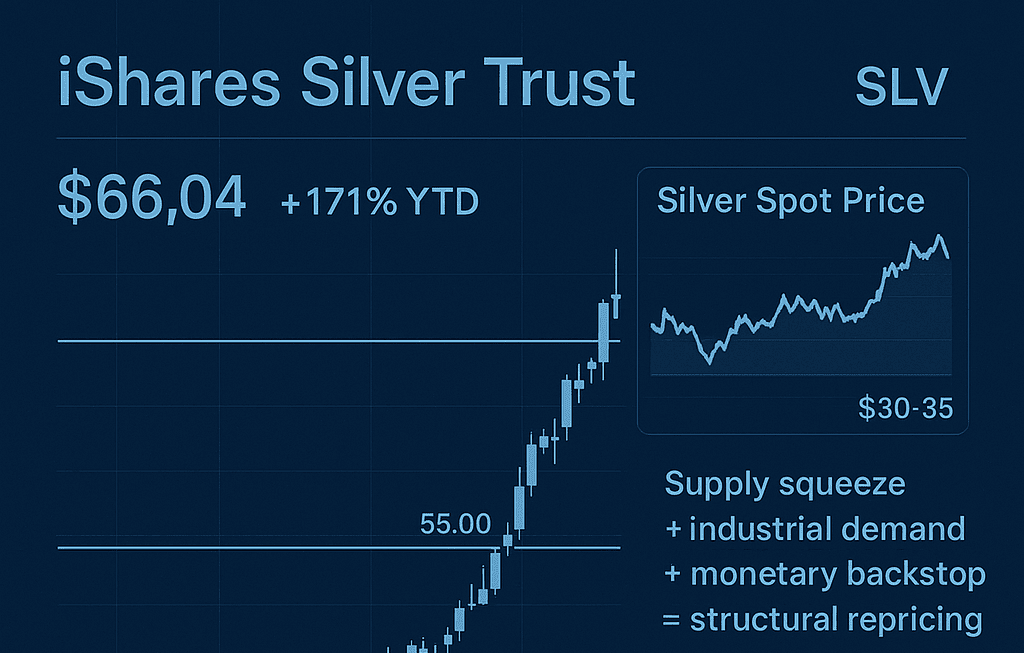
Silver is firmly entrenched in a multi-month uptrend, characterized by a consistent pattern of higher highs and higher lows. The recent breakout above the $50–$55 multi-decade resistance level has been emphatically confirmed by surging trading volumes, signaling strong conviction among market participants.
Chart Patterns
A massive cup-and-handle formation has completed on long-term charts, a highly bullish technical pattern. The measured move derived from this pattern targets the $75–$80 range, with Fibonacci extensions pointing towards ambitious levels of $88–$100, suggesting significant further upside potential.
Momentum Indicators
Momentum indicators reflect the market's strength. The Relative Strength Index (RSI) is well above 90, indicating an overbought condition, yet without major bearish divergence developing so far. The Moving Average Convergence Divergence (MACD) remains firmly bullish, and the Average Directional Index (ADX) above 25 confirms a strong underlying trend.
Key Support and Resistance
Immediate key support for silver is identified in the $56–$58 range. On the upside, significant resistance zones are located between $75–$80. A sustained close below the $56 level would signal a potential deeper retracement, possibly towards the $49–$51 area.
Macro & Fundamentals: Alignment or Divergence?
The current macroeconomic landscape appears largely aligned with silver's bullish narrative. A dovish Federal Reserve, a weaker U.S. dollar, persistent inflation concerns, and record industrial demand all reinforce the case for higher silver prices. However, a divergence exists in silver's extreme outperformance relative to gold, and sentiment/positioning are stretched, raising the risk of a sharp correction should macroeconomic winds shift unexpectedly.
Trade Bias: Conditional Buy with Caution
The prevailing trade bias suggests a buy on dips strategy, ideally above the $56–$58 support zone, with stringent risk controls in place. Confirmation for momentum continuation would be a sustained hold above $75 with robust volume. Conversely, a close below $56 would serve as an invalidation trigger, prompting an exit or reassessment of the position.
- Bullish Target: $88–$100
- Base Case Target: $75–$80
- Bearish Risk: $56–$58
- Invalidation: Close below $56
Options View: Defined-Risk Strategies Recommended
Given the record-high implied volatility in the silver market, strategies that define risk are highly advisable. Traders might consider vertical call spreads (e.g., $75/$85) to cap potential losses while participating in upside. Alternatively, cash-secured puts could be explored for those willing to take physical delivery at a lower price. Naked options should be avoided due to the extreme event risk stemming from potential policy surprises from China or the Federal Reserve.
2026 Forward-Looking Impact and Scenarios
Looking ahead to 2026, if China's export curbs remain in effect and the Federal Reserve maintains a dovish stance, silver could realistically test triple-digit prices. However, a reversal in Fed policy towards a hawkish pivot, an easing of supply constraints, or a significant demand shock (e.g., a slowdown in EV/solar adoption or a tech bust) would likely cap upside or trigger sharp corrections. Geopolitical tensions and rising fiscal risks also remain significant wildcards that could influence silver's trajectory.
Key Risks & Invalidation Triggers
- Fed Hawkish Pivot: A shift towards tighter monetary policy by the Federal Reserve would strengthen the U.S. dollar and exert downward pressure on silver prices.
- China Policy Reversal: Any easing or reversal of China's export restrictions would alleviate supply concerns and likely deflate the current "war premium."
- Demand Shock: A substantial slowdown in key industrial sectors like electric vehicles, solar energy, or general technology could significantly impact industrial silver demand.
- Technical Breakdown: A sustained close below the critical $56 support level would constitute a major technical breakdown, invalidating the current bullish structure.
Conclusion: What Traders Should Watch Next
As silver navigates this historic rally, traders and investors must remain vigilant. Closely monitor the implementation of China’s export policies, upcoming Federal Reserve minutes for any shifts in monetary stance, and the evolution of ETF flows. Furthermore, watch for exhaustion signals from technical indicators like RSI and volume divergence, alongside any signs of stress in the physical silver market. Given the extreme volatility, maintaining a nimble approach and adjusting risk exposure accordingly will be paramount for navigating the exciting, yet challenging, silver market ahead.