European Banks Fail to Capitalize on Trump Tariff Turmoil
As of late 2025, the much-anticipated “European Banking Renaissance,” expected to be fueled by US protectionism, has demonstrably failed to materialize. While the Trump Tariffs – encompassing a 20% baseline and various country-specific surges – indeed generated massive market volatility, the predicted rotation of European corporate clients away from Wall Street advisors towards domestic banks such as Barclays, Deutsche Bank, and BNP Paribas did not occur.
Paradoxically, US investment banks have leveraged this very turmoil to not only maintain but actually increase their market share in Europe. This detailed analysis delves into the structural, political, and technical reasons underpinning this significant strategic misstep by European financial institutions.
The "Safety in Scale" Paradox
Conventional wisdom suggested that escalating trade wars would foster "economic nationalism," prompting European firms to favor European banks for their sensitive capital needs. In practice, the opposite trend emerged.
- The US "Backchannel" Premium: Corporate CEOs across Germany, France, and Italy quickly recognized that engaging firms like Goldman Sachs or JPMorgan offered a critical strategic advantage. These US banks possess direct lines of communication to the US Treasury and the inner economic circle of the Trump administration. For a European company grappling with 30% tariffs, a US bank was perceived as an "insider" advisor uniquely positioned to navigate Washington's complex political landscape.
- Balance Sheet Superiority: The tariff shocks of April and August 2025 triggered sudden liquidity crunches for export-heavy sectors, including automotive and machinery. US banks, fortified by substantially higher capital reserves and more liquid balance sheets, were able to swiftly provide massive credit lines and bridging loans—a capacity that many European mid-tier banks simply could not match.
The Tech and AI Deficit
The year 2025 marked a pivotal shift, as "Agentic AI" transitioned from theoretical lab concepts to practical applications on trading floors. US banks had strategically invested billions into this transition during 2024, a move that paid significant dividends, while their European counterparts remained largely mired in legacy restructuring efforts.
- Execution Speed Advantage: High-volatility market environments inherently favor the fastest and most sophisticated algorithms. US firms' substantial investments in AI-driven execution and hedging tools allowed their trading desks to capture the overwhelming majority of "hedging flow" when tariff news broke, as European companies desperately sought to protect against sudden currency swings.
- Talent Brain Drain: As the bonus pools at Wall Street banks expanded significantly in 2025, buoyed by their AI-driven productivity gains, a notable number of top "rainmakers" from prominent European investment banks defected to US firms, taking their invaluable client relationships with them.
Fee Pool Dynamics and Market Share Shifts
European banks notably failed to safeguard their "home turf" fee pool. Recent data reveals a stark reality: in the EMEA (Europe, Middle East, Africa) region for 2025, US banks collectively captured an astonishing 37% of all investment banking fees. This compares to just 29% for European majors like Deutsche Bank, Barclays, and BNP Paribas.
Further illustrating this disparity, US majors (JPMorgan, Goldman Sachs, Morgan Stanley) reported an 18% net income growth for 2025, securing an impressive 80% win rate on the year's top 10 M&A deals. In contrast, European majors saw a modest 6% net income growth and participated in only 20% of the top M&A transactions, highlighting a significant competitive gap.
The "Contagion" of Uncertainty
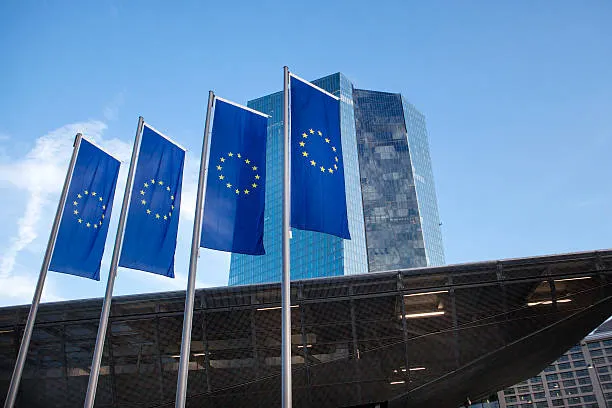
According to recent reports from the European Central Bank (ECB), the pervasive uncertainty generated by Trump’s tariffs had a profound "chilling effect" on domestic lending within Europe.
- Lending Contraction: Rather than seizing the opportunity to expand market share, European banks adopted a more risk-averse stance. They tightened credit supply to export-oriented sectors, effectively ceding this critical business to larger US wholesale banks and private credit funds, which were willing to assume the elevated risk for a premium.
- M&A Paralysis: While M&A activity surged in the US, partly driven by deregulation, European M&A remained largely muted as companies awaited "clarity" on the evolving trade landscape. Since European banks are more heavily reliant on regional deal flow, their advisory pipelines significantly diminished, whereas US banks simply pivoted their European teams to support US-outbound acquisitions.
Outlook: What Lies Ahead for European Banking in Q1 2026?
The current trajectory suggests two primary scenarios for the European banking sector in the immediate future.
Scenario A: The "National Champion" Merger (Probability: 60%)
If European bank fee share drops below 25% by the end of Q1 2026, we anticipate that the ECB and national governments will fast-track "super-mergers." Potential combinations, such as UniCredit-Commerzbank or BNP-SocGen, would aim to forge a "European JPMorgan" capable of competing on a truly global scale. This scenario would likely be bullish for European bank stocks in the short term due to anticipated M&A premiums.
Scenario B: The "Service Tariff" Escalation (Probability: 30%)
Should the Trump administration implement a "Financial Service Surcharge" – effectively taxing US banks' profits earned in Europe – European banks would finally gain a crucial price advantage. This would represent the only realistic catalyst for a massive rotation of business back to institutions like Deutsche Bank (DB) or Barclays (BARC).
Bottom Line
European banks entered the "Tariff War" expecting a significant home-field advantage but were ultimately outmatched by the superior geopolitical connectivity and unparalleled technological scale of Wall Street. For 2026, the sector remains an "underweight" recommendation for investors, unless a major cross-border merger provides the necessary scale to challenge the entrenched US hegemony.