Tesla's Delivery Reckoning: The AI Valuation Trap Exposed
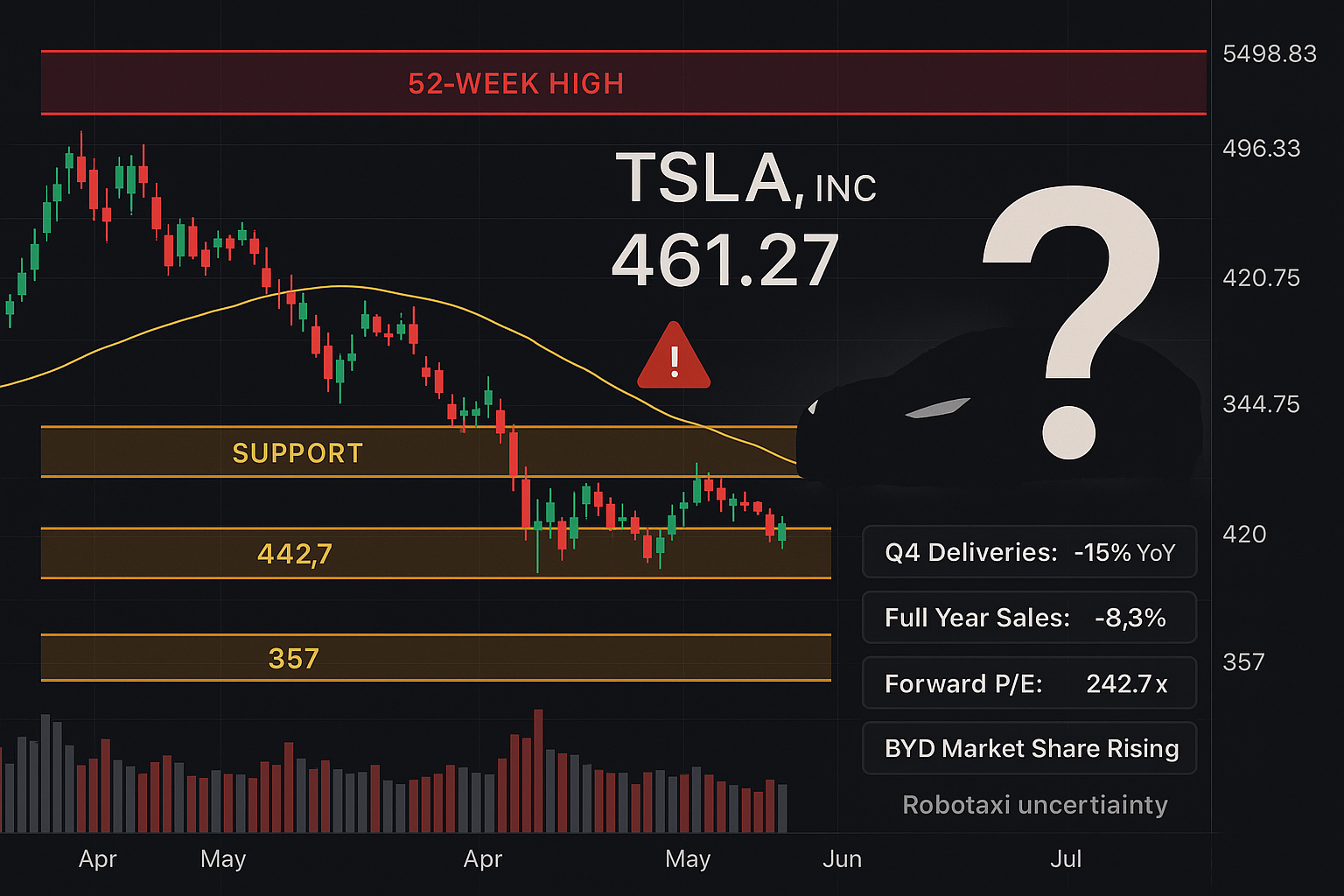
As of Tuesday, December 30, 2025, 5:54 PM CET, Tesla (NASDAQ: TSLA) trades at $461.27, reflecting a modest 0.35% increase. This muted market reaction belies a significant development: Tesla has for the first time released its own analyst consensus, projecting Q4 vehicle deliveries of just 422,850 units. This figure represents a brutal 15% year-over-year decline and falls short of Bloomberg's more optimistic forecast of 445,061. This strategic disclosure appears to be a calculated effort to manage expectations ahead of what is anticipated to be a disappointing December delivery report, confirming a second consecutive annual sales decline for the EV giant.
Yet, paradoxically, TSLA shares have climbed 14% for 2025, trading at an astronomical forward Price-to-Earnings (P/E) ratio of 242.7x. This profound valuation disconnect exposes a fundamental crisis beneath the surface of the prevalent AI hype: Tesla is an electric vehicle business facing structural decline, attempting to pivot its narrative towards a speculative future as a robotaxi and artificial intelligence powerhouse.
Decoding the Delivery Data: A Decline Unveiled
Tesla's self-compiled consensus data paints a stark picture of a company in structural decline. For the full year 2025, the company-compiled estimates point to approximately 1.64 million vehicle deliveries, an 8.3% decrease from 2024's 1.79 million. This marks the second consecutive year of sales contraction, a reality that should warrant serious concern for shareholders of a company with a market capitalization exceeding $1.5 trillion. However, Wall Street's narrative has largely shifted away from the core automotive business, instead anchoring on unproven robotaxi and artificial intelligence upside that remains purely speculative.
The Erosion of Market Share and Global Challenges
Further analysis reveals deeper issues. Gene Munster of Deepwater Asset Management estimates that Tesla pulled forward approximately 55,000 sales into Q3, capitalizing on the expiration of the $7,500 tax credit on September 30. This suggests that Q4's organic demand is likely even weaker than the reported 422,850 figure indicates. In the U.S. alone, Cox Automotive's Kelley Blue Book estimates Tesla sales at a mere 125,900 units for Q4, a staggering 22.4% decline from the previous year.
Globally, China, a critical market for Tesla, is experiencing significant challenges. Deliveries were down 8% through November, as formidable local rivals like BYD and Xiaomi aggressively capture market share with vehicles priced 30-50% cheaper. Elon Musk himself conceded during a recent earnings call, "Chinese EV manufacturers are extremely good. If not for trade barriers, they will pretty much demolish most other companies in the world." This statement underscores a critical point: Tesla's competitive moat in the EV sector is eroding, and without protectionist measures, Chinese rivals could render Tesla's core EV business significantly less competitive within a short timeframe.
The Robotaxi Dream vs. Reality: A Valuation Disconnect
The prevailing bullish narrative often hinges on the promise of robotaxis. ARK Invest, for instance, published a 2026 Tesla price target of $4,600 – a staggering 999% upside from current levels – with a 25% probability of exceeding $5,800. This ambitious thesis is almost entirely dependent on the successful and profitable deployment of robotaxis by 2026, with autonomous ride-hail revenue projected at $51 billion net and 37% EBITDA margins by that year, representing 60% of ARK's expected value.
Speculation vs. Tangible Progress
However, the reality on the ground presents a harsh contrast to these projections. Tesla currently operates approximately 500 fully autonomous vehicles primarily in San Francisco and Austin, a far cry from the "1 million plus fleet" implied by bullish narratives. Even Dan Ives of Wedbush, a notable Tesla bull, admits the actual fleet "is tracking smaller than anticipated." Significant hurdles remain, including uncertain regulatory approval, the absence of comprehensive autonomous insurance liability frameworks, and accelerating competition from established players like Waymo and others.
Given these challenges, the probability of Tesla developing a profitable robotaxi business generating $51 billion in revenue by 2026 appears mathematically negligible, casting a long shadow over the speculative component of its current valuation.
Technical Outlook and Valuation Concerns
Tesla shares peaked at $498.83 on December 18, experiencing a 7% pullback since then. The 50-day moving average (MA) currently sits at $444.75, offering a potential support level. However, the 200-day MA at $357.06 suggests a much larger potential downtrend if current momentum breaks. The Relative Strength Index (RSI) is in neutral territory, but volume patterns indicate institutional distribution, with large blocks of shares being offloaded at higher price points.
A Divergence from Fundamental Value
The forward P/E ratio of 242.7x is profoundly divorced from fundamental earnings, with an estimated EPS of $1.90 assuming near-zero profits. For context, traditional automotive stocks typically trade at 5-8x P/E, while even high-growth technology peers usually command P/E multiples of 20-40x. This stark disparity highlights the market's heavy reliance on future, unproven growth scenarios rather than current operational performance.
Investment Implications and Future Outlook
Optimal Action: Investors should exercise extreme caution at current levels. The 14% year-to-date gain appears to be driven purely by sentiment and speculative narratives. When the inevitable delays in robotaxi deployment and profitability become apparent in Q1-Q2 2026 (marked by a lack of material fleet announcements), the stock is likely to undergo a sharp repricing downwards. We suggest fading rallies above $470, targeting a move towards $420-$400. Should the stock decisively break below $380 on high volume, targets of $300-$330 become viable.
Bull Case Caveat
A significant shift in this outlook would only occur if (and only if) Tesla announces a verifiable fleet deployment of 50,000+ robotaxis in 2026 with concrete proof of profitability. In such an unlikely scenario, a target of $600+ could become viable. Until then, TSLA remains a "falling knife" with substantial downside risk.
Bottom Line: The $1.5 Trillion EV Company Isn't Worth $1.5 Trillion
Tesla is currently grappling with a declining core EV business, a struggling China strategy, mounting margin pressures, and a second consecutive year of sales contraction. While the AI/robotaxi narrative is compelling, it remains largely unproven and highly speculative. At a 243x forward P/E, there is virtually zero margin for error. The stock is best considered a sell on rallies, with the true reckoning anticipated in 2026 as these speculative narratives confront harsh reality.
Disclaimer: This article is for informational purposes only and does not constitute financial advice. Investing in technology and automotive stocks involves substantial risk, and investors should conduct their own due diligence or consult with a qualified financial advisor.